What to Do After Getting an EIN (Complete Business Checklist)

Gary Gal

After helping dozens of new business owners, I’ve seen confusion about which steps to take after getting an EIN, especially as deadlines pile up. In my experience, many clients rush ahead without knowing what to do, which often leads to costly mistakes.
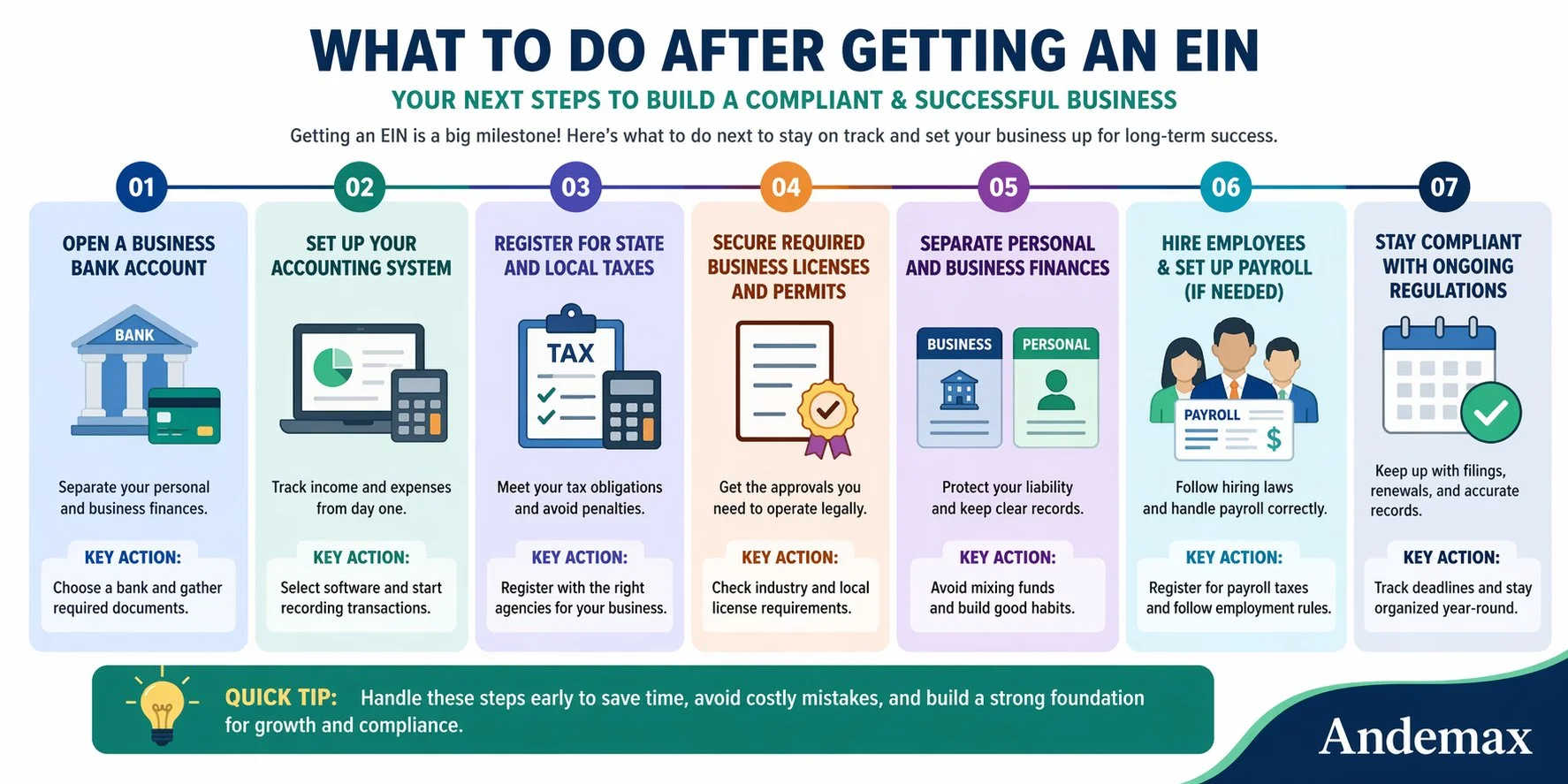
After receiving an EIN, the next steps include opening a business bank account, setting up accounting, registering for state taxes, and securing required licenses. You should also separate finances, hire employees properly if needed, and stay compliant with federal and local regulations.
So, getting clarity early can save you time, money, and stress as your business grows. Now, check the key takeaways to get an insight into what you will learn.
Key Takeaways
Separate personal and business finances: This prevents accounting confusion, protects liability, and avoids tax reporting errors.
Set up accounting immediately: Accurate records improve tax compliance, cash flow tracking, and financial decision-making.
Complete tax registration and licensing early: Doing this late can lead to penalties or restrictions that disrupt operations.
Maintain ongoing compliance: Tracking filings and renewals keeps your business in good standing and avoids avoidable fines.
Next, we will break down each step and what you need to do it correctly.
Why Does Getting an EIN Matter for Your Next Business Steps?
An Employer Identification Number is a unique tax ID assigned to a business entity. It enables proper identification for tax filing, banking, and legal compliance across federal and state systems.
With that in place, you can now focus on the key areas where this number becomes essential:
Business Area | Why the EIN Matters | What It Enables |
Banking | Verifies business identity | Open a business bank account |
Taxes | Tracks tax obligations | File federal and state taxes |
Hiring | Registers employer status | Set up payroll and hire staff |
Licensing | Confirms legal entity | Apply for permits and licenses |
Credit | Builds business profile | Apply for business credit |
Once an EIN is issued, it supports key steps like banking, taxes, and hiring. If the application process is still unclear, reviewing our guide on how to apply for an EIN helps ensure a proper start before moving forward.
Strengthen your post-EIN setup with accurate, compliant systems built for long-term growth without costly mistakes. [Schedule Your Business Setup Review Here] or call Andemax at (800) 344-5226 for expert guidance.
Open a Business Bank Account
A business bank account is a financial account dedicated solely to company transactions. Financial separation between personal and business activity ensures clean records and easier tax reporting.
With that, it will be easier for you to choose the right bank features and prepare the correct documents without delays.
Choose the right bank for your business needs
Selecting a bank involves evaluating services, fees, and accessibility based on business size. Different institutions offer varied features such as online tools, lending options, and transaction limits.
Review key banking features before making your final decision:
Compare monthly fees and minimum balance requirements
Check online banking and mobile app features
Evaluate customer service and branch accessibility
Review transaction limits and processing times
Prepare the documents required to open an account
Opening a business account requires submitting official documents that verify business identity. Banks typically request formation papers, EIN confirmation, and personal identification.
Gather all required verification documents before starting your business account application:
EIN confirmation letter from the IRS
Business registration or incorporation documents
Valid government-issued photo ID
Operating agreement (if applicable)
Business license (if required by your state or city)
Set Up Your Accounting System
An accounting system is a structured method for recording and managing financial transactions. Income tracking, expense categorization, and reporting accuracy all depend on a consistent system in place.
This foundation helps you decide between software options and build a consistent tracking routine that fits your workflow.
Select simple accounting software or a method that fits
Accounting software provides tools to automate financial tracking and reporting processes. It simplifies bookkeeping by organizing transactions and generating reports.
Evaluate available accounting system options based on your business needs:
Cloud-based accounting tools for real-time access
Spreadsheet-based systems for simple operations
Industry-specific software for specialized businesses
Integration with bank accounts for automation
Track income, expenses, and keep records organized
Financial tracking involves recording every transaction related to business activities. Consistent documentation ensures transparency and supports tax reporting requirements.
Follow a consistent financial tracking routine to maintain accurate business records:
Task | Purpose | Frequency |
Record income | Monitor revenue flow | Daily |
Log expenses | Track spending patterns | Daily |
Reconcile accounts | Ensure accuracy | Monthly |
Generate reports | Review performance | Monthly |
Register for State and Local Taxes
Tax registration is the process of enrolling a business with the relevant government agencies. Government authorities determine obligations such as sales tax, income tax, or payroll tax based on business activity and location.
Once this is clear, you can move into identifying your exact tax types and completing registrations with the correct offices.
Identify which taxes apply to your business
Different businesses are subject to various taxes depending on their activities and location. Common taxes include sales tax, payroll tax, and income tax.
Review the common tax categories that may apply to your business operations:
Sales tax for product-based businesses
Payroll tax for employers
Franchise or state business taxes
Local municipal taxes
Complete registrations with the correct agencies
Registering with tax authorities formalizes the business within government systems. Each jurisdiction may have different requirements and processes.
Follow the standard tax registration steps required by your state and local agencies:
Visit the state tax authority website
Complete online registration forms
Submit required documentation
Receive tax identification numbers
Secure Required Business Licenses and Permits
Licenses and permits are legal authorizations required to operate a business. Industry rules and local regulations define which approvals are mandatory before operations can legally begin.
From there, the next step is to review industry rules and apply for the permits tied to your specific location and operations.
Check industry-specific license requirements
Different industries require specific licenses to operate legally. Regulatory bodies define these requirements to maintain standards and safety.
Review the common industry-specific licenses and permits required for legal business operations:
Health permits for food-related businesses
Professional licenses for regulated services
Environmental permits for certain operations
Zoning approvals for physical locations
Apply for local permits based on your location
Local permits are issued by city or municipal authorities governing business activities. Requirements depend on local laws and business operations.
Identify the key local permits required based on your business location and operations:
Permit Type | Issuing Authority | Purpose |
Business permit | City hall | Legal operation approval |
Zoning permit | Local planning office | Location compliance |
Health permit | Health department | Safety standards |
Fire permit | Fire department | Risk compliance |
Separate Personal and Business Finances
Financial separation means maintaining distinct accounts and records for business activities. Mixing funds can distort financial clarity and weaken legal protection over time.
That structure makes it easier to set clear money habits and avoid mixing transactions from day one.
Avoid mixing funds to protect your business
Mixing personal and business funds creates accounting confusion and legal risks. It can complicate tax reporting and weaken liability protection.
Follow these best practices to keep personal and business finances properly separated:
Use dedicated business bank accounts
Avoid paying personal expenses from business funds
Maintain clear transaction records
Conduct regular financial reviews
Build clear financial habits from the start
Strong financial habits create consistency in managing business finances. Routine practices help maintain accurate records and support long-term growth.
Apply these core financial habits to build consistency and long-term stability in your business:
Schedule weekly financial reviews
Categorize expenses consistently
Monitor cash flow regularly
Maintain digital and physical records
Hire Employees and Set Up Payroll (If Needed)
Hiring employees requires establishing payroll systems and complying with labor laws. Wage processing, tax withholding, and reporting responsibilities must align with federal and state requirements.
Once staffing becomes part of the plan, you can focus on tax registration for payroll and meeting hiring regulations correctly.
Register for payroll taxes and reporting
Payroll tax registration enrolls a business with the authorities for employee-related taxes. It includes withholding income tax and contributing to social programs.
Complete these payroll tax registration steps to ensure proper compliance with employee-related obligations:
Register with federal tax authorities
Enroll in state payroll systems
Set up employee tax withholding
Maintain payroll records
Follow legal requirements when hiring staff
Employment laws regulate hiring practices, wages, and worker rights. Compliance ensures fair treatment and avoids legal disputes.
Understand the key legal hiring requirements every employer must meet to stay compliant:
Requirement | Purpose | Authority |
Employment contract | Define roles | Labor department |
Minimum wage compliance | Fair pay | Government |
Worker classification | Tax accuracy | IRS/state |
Workplace safety | Employee protection | OSHA/local |
Stay Compliant with Ongoing Regulations
Ongoing compliance involves meeting continuous legal and regulatory requirements. Filing deadlines, renewals, and documentation requirements form a continuous cycle of responsibility.
With the basics in place, staying on track comes down to managing deadlines and keeping your records audit-ready at all times.
Keep up with filing deadlines and renewals
Filing deadlines ensure the timely submission of tax returns and reports. Missing deadlines can result in fines and legal complications.
Track these critical filing deadlines and renewal requirements to maintain full business compliance:
Annual tax filings
Quarterly estimated taxes
License renewals
State report submissions
Maintain accurate records for audits and reviews
Recordkeeping involves storing financial and operational documents systematically. Accurate records support audits and legal verification processes.
Organize these essential recordkeeping practices to ensure audit readiness and reliable financial documentation:
Store financial statements securely
Maintain employee records
Keep tax documents accessible
Back up digital files regularly
Move your post-EIN business setup forward with accuracy, compliance, and zero costly delays. [Schedule Your Free Business Setup Review Here] or call (800) 344-5226 for expert assistance today.
How an Accounting Firm Can Help Businesses That Just Got an EIN?
An accounting firm provides structured financial and compliance support for businesses newly issued an Employer Identification Number. This support ensures proper setup of banking, tax registration, and bookkeeping systems aligned with regulatory requirements.
Below highlights key ways professional accountants guide each step so you can build a compliant and organized foundation:
Business bank account setup and document preparation
Tax registration support for federal, state, and local requirements
Accounting system setup tailored to business structure
Bookkeeping setup for income and expense tracking
Payroll registration and compliance for hiring employees
License and permit identification by industry and location
Ongoing compliance tracking for filings and renewals
Keep your business compliant and financially organized after receiving an EIN by exploring our expert accounting support services.
Summary Table: Post-EIN Business Checklist
Step | Key Action | Outcome |
Open a bank account | Separate finances | Financial clarity |
Set up accounting | Track transactions | Accurate reporting |
Register taxes | Meet obligations | Legal compliance |
Secure licenses | Obtain permits | Authorized operation |
Separate finances | Avoid mixing funds | Liability protection |
Hire employees | Set up payroll | Workforce compliance |
Maintain compliance | Track deadlines | Business continuity |
Conclusion
Most businesses don’t know what to do after getting an EIN and rush into banking, tax, and hiring steps without structure. In reality, the real risk is not the EIN itself but how poorly the next systems are built around it.
A common mistake that we see is that they assume financial institutions and tax agencies automatically match records, when they often operate in separate systems. The cost of getting this wrong is penalties, rejected applications, and audit stress, while doing it right creates clean compliance and stronger financial credibility.
When handled correctly, this stage becomes a protective layer for the entire business instead of a point of failure. For a confidential review and expert guidance, contact our Great Neck Estates firm at Andemax on (800) 344-5226 before small setup gaps turn into expensive corrections.
Frequently Asked Questions
What happens immediately after getting an EIN?
After receiving an EIN, the business must open a bank account and set up accounting systems. These steps establish financial organization and prepare the business for tax compliance and daily operations.
Is opening a business bank account required after getting an EIN?
Opening a business bank account is not always legally required, but strongly recommended. It ensures financial separation and simplifies bookkeeping, tax filing, and professional transactions.
How soon should tax registration be completed after receiving an EIN?
Tax registration should be completed as soon as business activities begin. Early registration prevents penalties and ensures proper handling of tax obligations from the start.
Can a business operate without licenses after getting an EIN?
Operating without required licenses can lead to fines or closure. Businesses must secure all necessary permits before starting operations to remain compliant with local regulations.
Do all businesses need an accounting system after getting an EIN?
Every business benefits from an accounting system, regardless of size. It ensures accurate financial tracking and supports better decision-making and compliance.
Is it necessary to separate personal and business finances?
Separating finances protects personal assets and simplifies accounting processes. It also strengthens legal protections, especially for limited-liability business structures.
What compliance tasks should be prioritized after getting an EIN?
Key compliance tasks include tax filings, license renewals, and maintaining accurate records. Staying organized ensures smooth operations and avoids penalties or legal issues.