How Contractors Should Track Project-Based Income: A Guide to Job Costing

Gary Gal
After experiencing working with contractors, I've seen how poor job tracking and weak costing systems quietly drain profits from growing teams. Time and again, at Andemax, we help them fix income leaks by improving how they manage contractors' work, job budgets, and costing across every project.
Because of this, contractors should track project-based income by assigning all costs and revenue to each job, then comparing estimates to actual results. This approach makes it easier for contractors to control job performance, improve costing accuracy, and protect profits.
So if you want clear numbers and better decisions, you need a system that fits how your projects really run. In the rest of this guide, you'll learn how to set up and use it without adding extra complexity.
Key Takeaways
Track costs and revenue per job, because aggregate numbers hide profit leaks. You only see real profitability at the project level.
Separate direct and indirect costs correctly, because errors distort margins. Clean allocation prevents misleading profit results.
Compare estimates to actuals often, because delays hide overruns. Early checks protect margins before problems escalate.
Use past job data for bids, because guessing leads to underpricing. Historical results improve pricing accuracy and profit control.
What is Job Costing for Contractors and Why Does it Matter?
Job costing for contractors is a financial method that tracks project-specific costs and revenue to measure true profitability. It works by assigning every expense and income source directly to individual jobs, which improves financial accuracy.
To better understand its impact, you will find the key benefits and outcomes outlined in the table below:
Key Aspect | Description | Outcome |
Cost Tracking | Links all expenses to specific jobs | Clear visibility into spending |
Revenue Monitoring | Records income per project | Accurate profit measurement |
Performance Analysis | Compares estimates to actuals | Identifies inefficiencies |
Financial Control | Tracks ongoing project costs | Prevents budget overruns |
Decision Support | Uses data for planning | Improves future project outcomes |
Strengthen your job costing accuracy, protect project margins, and bring clarity to every contractor project with expert accounting support built for real-world operations. [Schedule Your Project Costing Review Here] or call Andemax at (800) 344-5226 for confidential guidance.
Assigning Costs and Revenue to Each Job
Assigning costs and revenue to each job is the process of linking all financial activity directly to specific projects. However, inconsistent tracking and misallocated overhead often create inaccurate cost data and reduce financial clarity.
A closer look at the next sections will help you understand direct costs, indirect costs, and revenue tracking per project.
Direct Costs: Labor, Materials, Equipment
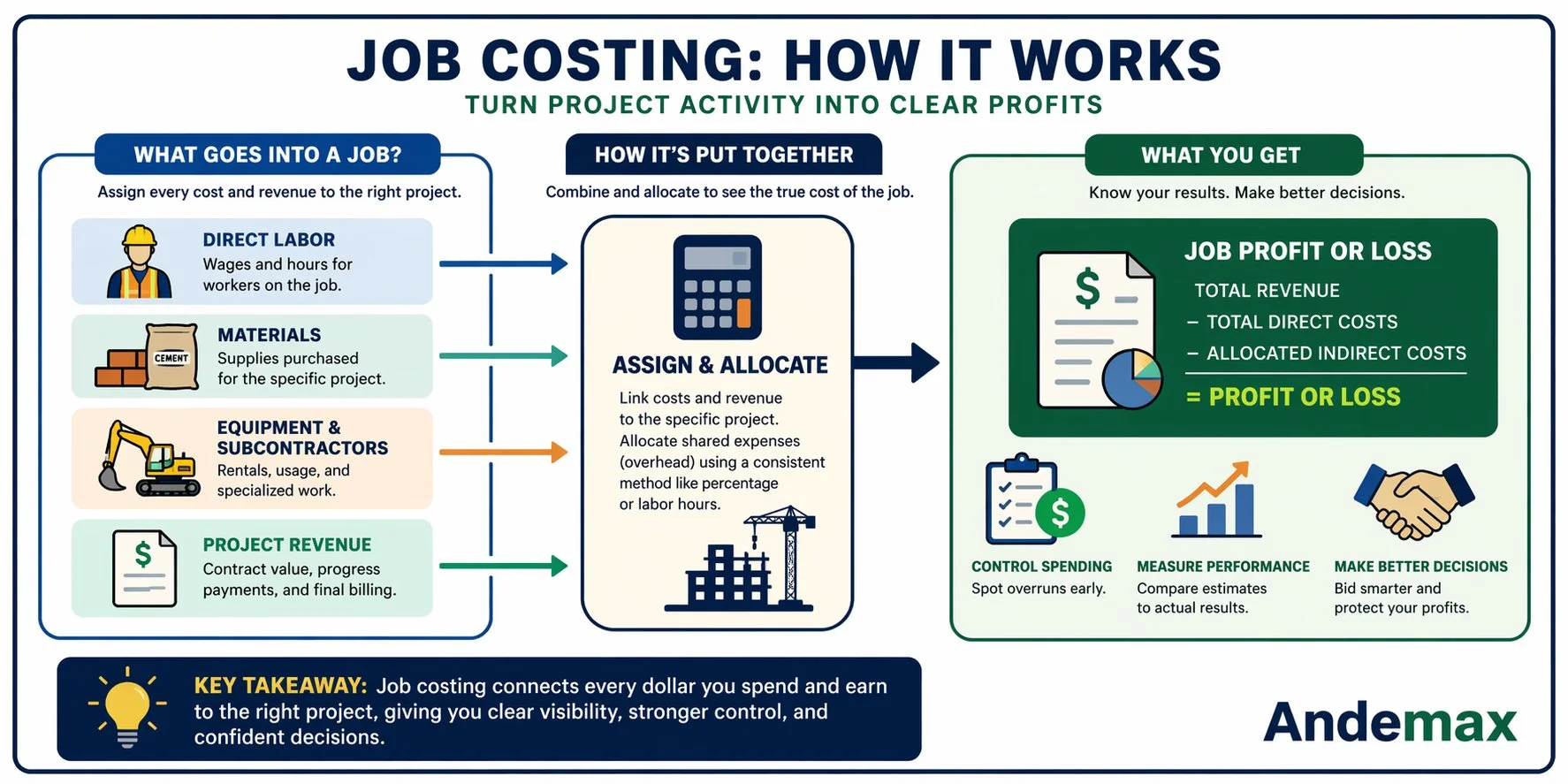
Direct costs are expenses directly tied to a specific project, including labor, materials, and equipment used for that job. These costs are essential because they account for the largest share of project spending and directly affect profitability.
For a clearer breakdown of what to track, the key direct cost components are listed below:
Labor costs for workers assigned to the project
Materials purchased specifically for the job
Equipment rentals or usage tied to one project
Subcontractor payments for specialized work
Accurate daily tracking of direct costs prevents small errors from turning into major profit losses.
Indirect Costs: Overhead and Shared Expenses
Indirect costs are shared expenses that support multiple projects but are not directly linked to a single job. These costs matter because improper allocation can distort project profitability and lead to inaccurate financial reporting.
To better understand how these costs are categorized and assigned, you will find the key indirect cost types and allocation methods outlined below:
Indirect Cost Type | Example | Allocation Method |
Office Rent | Monthly lease | Split across projects |
Utilities | Electricity, water | Based on usage or percentage |
Admin Salaries | Office staff | Distributed evenly or by revenue |
Consistent allocation methods improve accuracy and make financial comparisons across projects more reliable.
Revenue Tracking Per Project
Revenue tracking per project records all income generated from a specific job, including contracts and payments. This process ensures accurate financial visibility by linking revenue directly to project performance and timelines.
From here, you can follow the step-by-step workflow to manage revenue tracking more effectively:
Record contract value at project start
Track progress payments or billing milestones
Monitor final payments and adjustments
Compare total revenue against total costs
Before breaking revenue down by project, many contractors first establish structured income tracking for small businesses to ensure all cash inflows are properly recorded.
Comparing Estimates to Actual Results
Comparing estimates to actual results measures how closely planned project costs match real financial outcomes. In practice, poor data tracking and delayed reporting often make it difficult to identify cost overruns early.
The following sections will guide you through setting estimates, tracking actual costs, and identifying variances early.
Setting Clear Project Estimates
Clear project estimates define expected costs, timelines, and resources before work begins on a specific job. Accurate estimates matter because they create a baseline that supports cost control and performance evaluation.
To build reliable estimates, you can focus on the key elements listed below:
Define labor hours and rates
Estimate material quantities and costs
Include contingency allowances
Set realistic project timelines
Using historical project data improves estimate accuracy and reduces the risk of cost overruns.
Tracking Actual Costs in Real Time
Real-time cost tracking records expenses immediately as they occur throughout the project lifecycle. Timely data capture reduces reporting delays and helps detect overspending before it affects overall project budgets.
With this approach in place, you can follow the steps below to maintain accurate and up-to-date cost records:
Use digital tools to log expenses daily
Monitor labor hours through timesheets
Track material usage as it happens
Update cost reports regularly
Daily cost updates improve accuracy and allow faster response to budget issues.
Identifying Cost Variances Early
Early identification of cost variances detects differences between estimated and actual costs before they escalate. This process matters because timely detection allows corrective actions that prevent budget overruns and protect margins.
For a clearer view of common variance types and responses, you can review the key data points below:
Variance Type | Cause | Action |
Labor variance | Overtime or delays | Adjust schedules |
Material variance | Price changes | Source alternatives |
Equipment variance | Breakdowns | Improve maintenance |
Regular variance reviews help catch issues early and keep projects aligned with budget expectations.
Evaluating Job Profitability and Performance
Evaluating job profitability and performance determines whether projects meet financial and operational targets. Yet, incomplete data and inconsistent reporting can limit the accuracy of profit analysis across multiple jobs.
The sections ahead will show you how to calculate profit, spot patterns, and use insights to improve future bids.
Calculating Profit Per Job
Profit per job is calculated by subtracting total project costs from total revenue earned on that job. This calculation matters because it reveals true financial performance and supports better pricing and budgeting decisions.
Here is a clear breakdown of the required data points that will help you calculate profit accurately:
Total revenue from the project
Total direct costs
Allocated indirect costs
Final profit or loss figure
Always include both direct and indirect costs to avoid overstating profit margins.
Spotting Patterns Across Projects
Pattern analysis across projects identifies recurring trends in costs, performance, and overall financial outcomes. This process matters because consistent patterns reveal inefficiencies or strengths that influence long-term business decisions.
With this in mind, the following steps will help you analyze project data and uncover meaningful trends:
Review past project reports
Identify recurring cost overruns
Analyze profit margins across jobs
Adjust future estimates based on findings
Regularly reviewing past projects improves forecasting accuracy and strengthens future planning decisions.
Using Insights to Improve Future Bids
Applying project insights improves future bids by using past data to create more accurate and competitive proposals. This approach matters because data-driven estimates reduce pricing errors and increase the chances of winning profitable projects. Building on these insights, the key actions below will help you refine and strengthen future bids:
Use historical cost data for estimates
Adjust pricing based on past performance
Factor in known risks and delays
Refine timelines using real project data
Consistently updating historical data ensures future bids remain accurate and competitive.
Take control of project profitability by tightening job costing accuracy, reducing cost leaks, and improving financial clarity across every contractor job. [Schedule Your Free Job Costing Review Here] or call Andemax at (800) 344-5226 for expert guidance today.
How an Accounting Firm Can Help Contractors Improve Job Costing and Profit Control?
Accounting firms strengthen contractor profitability by bringing structure and accuracy to job costing and financial control. Many contractors struggle with inconsistent cost tracking, leading to unclear margins and poor bidding decisions.
The key services that solve these issues are outlined below:
Setting up structured job costing systems per project
Allocating costs accurately across labor, materials, and overhead
Delivering real-time project financial reporting
Identifying profit leaks through variance analysis
Improving bid accuracy using historical data
Supporting cash flow management across projects
Keep contractor finances accurate, organized, and profit-ready with our expert accounting support designed to strengthen job costing and control margins.
Summary Table: Key Components of Effective Job Costing
Component | Purpose | Key Benefit |
Cost Assignment | Track expenses per job | Accurate financial visibility |
Revenue Tracking | Monitor income per project | Clear profit measurement |
Estimate Comparison | Compare planned vs actual | Identify inefficiencies |
Profit Evaluation | Calculate job performance | Improve decision-making |
Data Analysis | Review trends across jobs | Enhance future planning |
Conclusion
Proper job costing for contractors is not an optional accounting detail; it is the backbone of reliable project profitability control. When executed correctly, it separates sustainable work from projects that quietly drain cash without early warning signs.
A common blind spot seen in practice is overlooking how shared overhead gets distributed across active jobs, which distorts true margins. The cost of this error is mispriced work and shrinking profit, while accurate allocation creates stability and confident bidding.
Andemax reviews often uncover these gaps before they escalate into long-term financial strain. For a confidential assessment of the accuracy of project costing, contact our Great Neck Estates firm at (800) 344-5226.
Frequently Asked Questions
What is job costing in construction?
Job costing in construction tracks all costs and revenue tied to a specific project. It helps measure profitability and ensures accurate financial management across different jobs.
Why is job costing important for contractors?
Job costing helps contractors understand where money is spent and earned on each project. It improves budgeting, reduces waste, and supports better decision-making.
What are direct and indirect costs in job costing?
Direct costs are expenses tied to a specific project, like labor and materials. Indirect costs are shared expenses, such as office rent and administrative salaries.
How do contractors track project-based income?
Contractors track project-based income by recording all revenue linked to each job. This includes contracts, progress payments, and final billing amounts.
What tools can help with job costing?
Digital accounting and project management tools help track costs and revenue in real time. These tools improve accuracy and reduce manual errors.
How often should job costing data be reviewed?
Job costing data should be reviewed regularly, ideally weekly or monthly. Frequent reviews help catch issues early and maintain financial control.
Can small contractors benefit from job costing?
Yes, small contractors benefit by gaining clear insights into project profitability. Even simple systems can improve cost tracking and financial outcomes.